
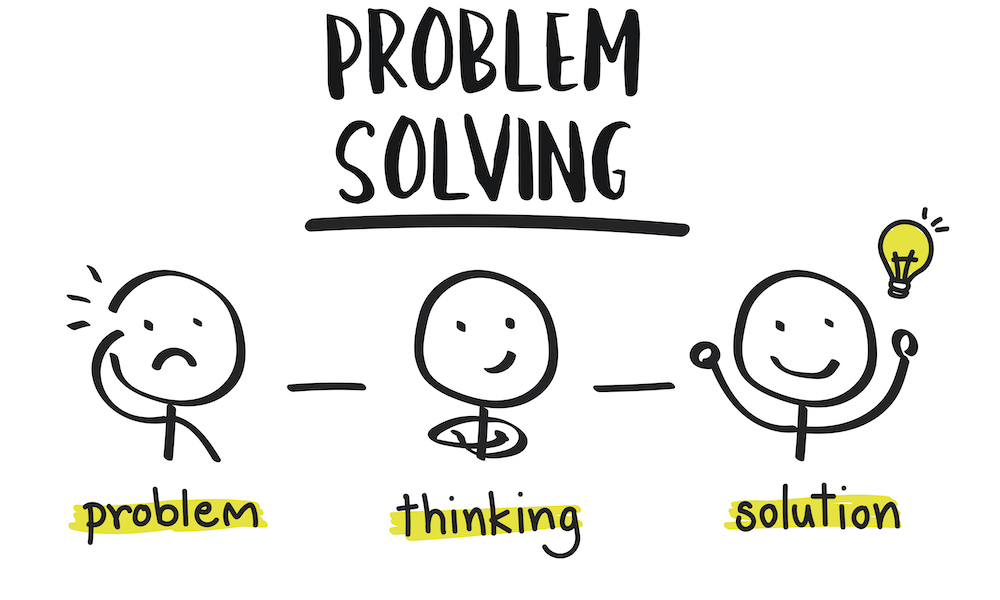
Learn more about this CPS innovation methodology here.
When it comes to developing innovative solutions to unique organizational challenges or your own life, using tried and true methods to brainstorm ideas and find the best possible solution can be a great way to achieve your goals. One such methodology is creative problem solving, which will be defined and explored in this latest article from Innovation Training.
What is creative problem solving?
Creative problem solving is a method for solving problems or identifying opportunities in an innovative way. The methodology was developed by Alex Osborn and Sid Parnes in the 1940s as the “Osborn-Parnes Creative Problem Solving Process”. This initial thought process has led to later models, including the 2011 Creative Problem Solving (CPS) Learner’s Model from the Creative Education Foundation. Despite its long history, creative problem solving is still incredibly valuable today and is used in many creative pursuits and industries.
Why you may want to use creative problem solving
Overcoming challenges and finding new ways of doing things is difficult and can be costly. Using a trusted approach like creative problem solving can help you develop the ability to find these innovative solutions and generate many different ideas to use in your project or challenge.
CPS helps you think in new ways by separating divergent and convergent thinking. While divergent thinking, or brainstorming, generates lots of potential possibilities, convergent thinking involves evaluating and choosing the most promising one. Oftentimes, we suffer by combining these two processes into one, stifling idea generation. By thinking of them as separate processes, you can generate more ideas and evaluate them more fairly later on.
Four principles of creative problem solving
CPS is based on a few key assumptions:
- Divergent and convergent thinking must be balanced
- Problems are open-ended questions with multiple possibilities
- Judgment and assumptions should be suspended in the brainstorming process
- Focus on “Yes and” versus “No but”
This last principle refers to the idea that it is better to use language such as “yes and” that allows continuation and expansion, versus a word such as “but” that negates and closes the conversation.
How to use creative problem solving techniques
The simplest form of the creative problem solving process involves four steps:
- Clarify – define the objectives, the problem, the facts, and the opportunity to achieve
- Ideate – brainstorm many possible solutions or approaches
- Develop – further develop your ideas by turning them into experiments
- Implement – create a plan and move forward with next steps
From an innovator’s perspective, we tend to add a few more steps in the mix that help further establish the problem and allow for evaluation and experimentation of ideas. The process therefore can look like this:
- Clarify – define the objectives, the problem, the facts, and the opportunity to achieve
- Research – learn more about the problem, stakeholders, and other involved entities
- Generate ideas – brainstorm many possible solutions or approaches
- Combine and evaluate – review ideas and narrow in on the best opportunities
- Solve – further develop your “winning” ideas by turning them into experiments
- Iterate – test your best idea and get feedback, iterate based on what you find out
- Implement – create a plan and move forward with next steps for the “winning” solution
Related guide: See also a 7-step problem-solving process for teams.
Creative Problem Solving FAQ: Answers to 10 Common Questions
These are the questions people ask most often when they start using creative problem solving, whether on their own, with a team, or in a workshop. Each answer is short and practical, with links to deeper resources where they help.
1. What is creative problem solving?
Creative problem solving (CPS) is a structured process for finding new solutions to open-ended challenges. It moves through clarifying the challenge, generating many ideas, developing the most promising ones, and planning action, and it separates divergent thinking (generating options) from convergent thinking (choosing among them) at every stage. The approach grew out of the work of Alex Osborn and Sid Parnes in the mid-twentieth century and has been refined by researchers and practitioners ever since. Its value is that it makes creativity repeatable: a team can follow the same steps on a strategy question, a customer problem, or a culture challenge and get better results than an unstructured discussion.
2. How can I become more creative?
Creativity behaves more like a skill than a fixed trait, so it grows with practice. Three habits make the biggest difference. First, separate idea generation from judgment, and give yourself permission to list many ideas before deciding anything. Second, expose yourself to inputs from outside your field, such as other industries, books, conversations, and travel, since new ideas usually come from connecting existing ones in a new way. Third, practice regularly on small challenges. An exercise like the 100 ideas exercise builds fluency quickly, because by idea 40 or 50 you have exhausted the obvious answers and start finding original ones.
3. What are some common creative problem solving techniques?
Most CPS techniques fit into one of the process stages. For clarifying a challenge, teams use “How might we…” questions, the 5 Whys, and challenge mapping. For generating ideas, common techniques include brainstorming and brainwriting, SCAMPER, forced connections, and Six Thinking Hats. For more technical problems, TRIZ offers a systematic set of inventive principles. For choosing and developing ideas, teams use dot voting, evaluation matrices, and PPCO (pluses, potentials, concerns, and overcoming concerns). Our guide to creative problem solving techniques covers many of these in more depth.
4. How do I know if I’m stuck in a fixed mindset?
A fixed mindset shows up in the way you talk about a challenge. Listen for phrases like “I’m just not a creative person,” “We tried that before,” or “That will never work here.” Other signs include avoiding challenges where you might fail, dismissing ideas before exploring them, and feeling threatened by other people’s good ideas. A growth mindset treats creative ability as something you can develop and treats a failed idea as information. The first step is simply noticing the fixed-mindset voice, then asking “What would I try if I knew I could learn from it?” Our growth mindset training resources cover this in more detail.
5. How can I overcome creative blocks?
Creative blocks usually come from one of three sources: pressure to find the perfect answer, too little new input, or fatigue from staring at the same problem. Try reframing the challenge with a different “How might we…” question, since a new question often breaks the logjam. Change your inputs by talking to someone outside the problem or looking at how another industry solves something similar. Lower the stakes by aiming for bad ideas on purpose, which often leads to good ones. And step away: many people find that their best ideas arrive on a walk or in the shower, after they have stopped forcing it. We have written more about how to get unstuck in your mindset to innovate.
6. How can I encourage creativity in my team or organization?
Teams are creative when it feels safe to share half-formed ideas. Leaders build that safety by asking questions before offering answers, by responding to new ideas with “yes, and” before raising concerns, and by treating small experiments that fail as learning. Give people a shared process, such as CPS or design thinking, so creative work has structure and does not depend on a few outspoken people. Make time for it, since creativity rarely survives a calendar packed with status meetings. Finally, act on some of the ideas people generate, because nothing ends idea sharing faster than suggestions that disappear. Our creativity and innovation training helps teams build these habits together.
7. What are some ways to generate new ideas?
The most reliable way to get good ideas is to generate many of them, so choose methods that produce quantity. Brainwriting, where people write ideas silently before sharing, often produces more ideas than open brainstorming because everyone contributes at once. Asking “How might we…” questions from several angles opens different directions. SCAMPER prompts you to substitute, combine, adapt, modify, put to another use, eliminate, or reverse parts of an existing solution. Analogies help too: ask how a hotel, a game designer, or a hospital would approach your challenge. Set a target number, such as 50 ideas in 15 minutes, to push past the obvious first answers. For more options, see our list of popular innovation exercises.
8. How do I evaluate and choose the best solution to a problem?
Start by agreeing on criteria before looking at the options, such as impact, cost, speed, and fit with your goals. Then narrow the list in stages. A quick dot vote identifies the ideas with the most energy, and an evaluation matrix scores the shortlist against your criteria. For the top one or two ideas, use PPCO: list the pluses, the potentials (what the idea could lead to), and the concerns, then brainstorm ways to overcome each concern. This protects promising ideas from being killed by the first objection. When you are still unsure, run a small, cheap experiment and let real feedback decide.
9. How can I apply creative problem solving to my work or personal life?
Pick a real, current challenge and phrase it as a question that starts with “How might I…” or “How might we…”, such as “How might we make our team meetings shorter and more useful?” or “How might I find more time for learning this year?” Then follow the steps: gather a few facts, list at least 20 ideas without judging them, choose one or two to try, and plan a small first step with a date. At work, CPS fits naturally into strategy sessions, process improvement, leadership retreats, and team planning. In personal life, it works well for career decisions, learning goals, and any situation where you feel you have run out of options.
10. How can I measure the effectiveness of my creative problem solving efforts?
Measure both the process and the results. Process measures include how many ideas a session generates, how many move into testing, and how quickly a team goes from idea to first experiment. Results measures include how many ideas are implemented, and what they achieve: time or cost saved, revenue, customer or employee satisfaction, or a problem that finally stays solved. Team measures matter as well, such as whether people report more confidence in sharing ideas and whether participation widens beyond the usual voices. Review these measures after a few months rather than after a single session, since creative capability builds over time. For a broader framework, see our guide on how to build and measure an innovation program.
Creative Problem Solving Process Conclusion
In this article, we explored the creative problem solving process (CPS) and how to use the technique to solve your own innovation challenges. Want personalized help using this method in your workshop or innovation event? Reach out to us online today about a creative problem solving training workshop.
Want even more creativity, problem solving, and innovation resources? Review this guide to creative problem solving techniques training and creative problem solving templates post.