

Explore creative problem solving techniques, activities, and articles.
If you find your organization or business stuck in a rut, unable to evolve or adapt to changes in your industry or customer expectations, it may be time to try a new approach. Using innovative techniques can help you develop better solutions to problems your organization faces. One such approach is creative problem solving, a methodology focused on divergent thinking. Learn more about this methodology and discover creative problem solving techniques, activities, and more articles to read below.
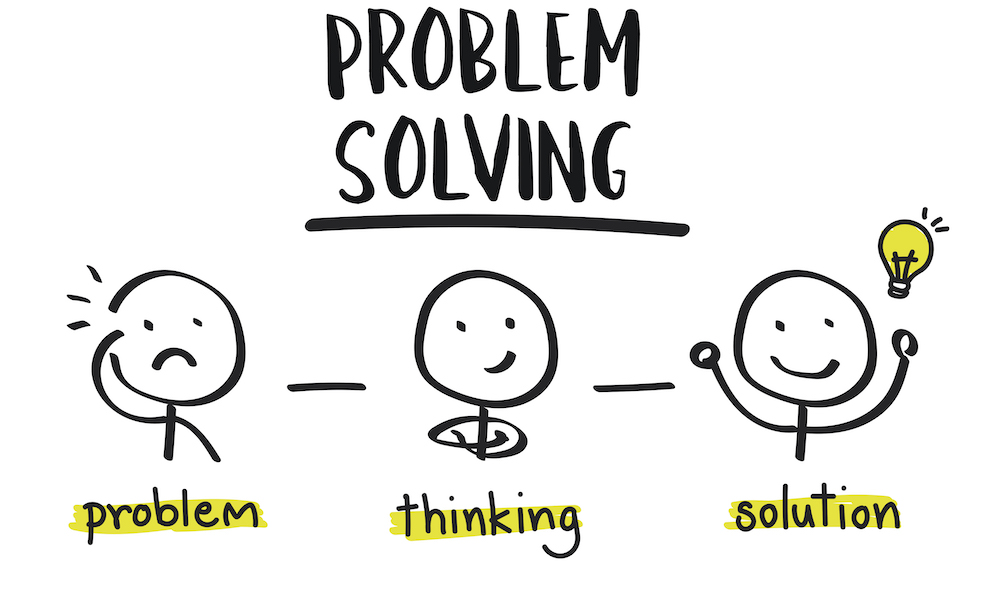
What is Creative Problem Solving?
Creative problem solving (CPS) is a method that encourages you to find new perspectives and come up with innovative solutions. Conventional thinking is countered with looking at the problem in a different way.
Founded in the 1940s by Alex Osborn (founder of the Creative Education Foundation), creative problem solving is often a valuable tool in your innovation arsenal. In the later half of the 2010s, this model was reworked to four steps that can be used to generate innovative, effective solutions for organizations and businesses.
Principles of Creative Problem Solving
- Divergent and convergent thinking must be balanced – know when to practice each one
- Rephrase problems as open-ended questions
- Defer or suspend judgement – let the ideas flow
- Focus on “yes, and” rather than “no, but” language
4 Steps of the Creative Problem Solving Process
(Click the link above to learn more about each of these!!!)
- Clarify: explore the challenge and gather data
- Ideate: brainstorm and explore ideas
- Develop: evaluate ideas and formulate solutions
- Implement: develop a plan of action
Creative Problem Solving Techniques & Activities
There are many techniques and activities that can be used to apply the creative problem solving methodology to your unique challenge. Here are a few basic techniques to get started:
1. Ask Compelling Questions
Phrase your challenge or problem in different ways. Use “what if” “why not”, etc.
2. Explore Context
Make sense of your challenge by examining it from many angles and putting it in context.
3. Switch Roles
Shift your perspective in order to see the challenge or possible solutions in a new light. For example, put on a “marketing hat” if you are an engineer.
4. Take a Break
Sometimes you need to walk away from the challenge and give your mind some time to reflect and think in the background.
5. Generate Many Ideas
Generate as many ideas or thoughts as you can related to the challenge. Don’t eliminate anything (even ideas that at first glance seem incorrect) until after you are done with the ideation process.
6. Get Visual with an Action Plan
Draw up an action plan with the simple, basic steps you’d need to take in order to implement your idea. Make it visual and break down these steps into more complex tasks and requirements.
7. Prototype and Test Solutions
One mistake many organizations make is not properly testing their ideas before implementation. Take the time to prototype your identified solution. Get real feedback from the people who would be impacted by the solution if possible.
More Creative Problem Solving Techniques to Try
The seven techniques above are a good starting point. These are the ones we reach for most often once a group is comfortable with the basics.
8. SCAMPER
Run an existing product, service or process through seven prompts: substitute, combine, adapt, modify, put to another use, eliminate, and reverse. Useful when a group is improving something that already exists rather than starting from a blank page.
9. How Might We Questions
Convert a problem statement into several “how might we” questions at different levels of ambition. A group that generates six framings before ideating almost always produces better ideas than one that accepts the first.
10. Brainwriting
Participants write ideas silently and pass them on for others to build on. This removes the airtime problem in groups where a few voices dominate, and it usually produces more ideas per minute than talking.
11. Assumption Reversal
List what everyone believes to be true about the challenge, then deliberately reverse each assumption and explore what becomes possible. Good for challenges a team has been stuck on for a long time.
12. Analogous Inspiration
Look at how a completely different industry solves a structurally similar problem. Hospitals have learned from pit crews, and retailers from theme parks.
13. Six Thinking Hats
Give the group one mode of thinking at a time so everyone is being optimistic, critical or emotional together rather than at cross purposes. See our guide to Six Thinking Hats for the full method.
14. Crazy Eights
Eight ideas sketched in eight minutes. The time pressure is the point: it pushes people past their first and most obvious answers.
Choosing the Right Technique
Having many techniques available matters less than picking one that fits the moment. A few rules of thumb we use:
If the group is stuck on defining the problem, use How Might We questions or assumption reversal before generating anything. If the group generates ideas easily but they all look alike, use analogous inspiration or SCAMPER to force distance. If a few people are dominating, switch to brainwriting or Crazy Eights so everyone produces in parallel. If the group is arguing, Six Thinking Hats separates the argument into modes and usually defuses it. And if energy is low, shorten the timebox rather than lengthening it.
The most common mistake is running one long unstructured brainstorm. Two or three short, differently structured rounds will produce more and better ideas than an hour of open discussion.
You can also work from prepared creative problem solving templates and our online brainstorming templates, which save setup time in virtual sessions.
Creative Problem Solving Articles
Want to learn more about creative problem solving? These articles and books are from top innovation resources that can help.
1. How You Define the Problem Determines Whether You Solve It
This Harvard Business Review article outlines how memory and the way you define or explain a problem can help you find the right solution.
2. Behind Every Breakthrough is a Better Question
This downloadable guide provides a framework for asking better questions and re-framing problems to lead to a better solution.
3. The Creative Thinking Handbook
This step-by-step guide provides practical tools and strategies to unlock creativity and develop your problem solving skills.
4. Design Thinking: A Guide to Creative Problem Solving for Everyone
This book covers creative problem solving and design thinking in an easy-to-understand and implement way. Apply these frameworks to solve organizational challenges or problems.
5. Creative Problem Solving Templates
These templates can also be helpful for the “doing” part of creative solving. Challenge yourself to go beyond reading to real problem solving.
Creative Problem Solving Techniques Training Conclusion
Creative problem solving is an innovative methodology that can help your organization find new and evolutionary solutions to your questions or problems. If your organization needs help implementing creative problem solving training, contact us today to get started. View our creative problem solving workshops, innovation workshops and design thinking training workshops to see more of what we teach and coach.